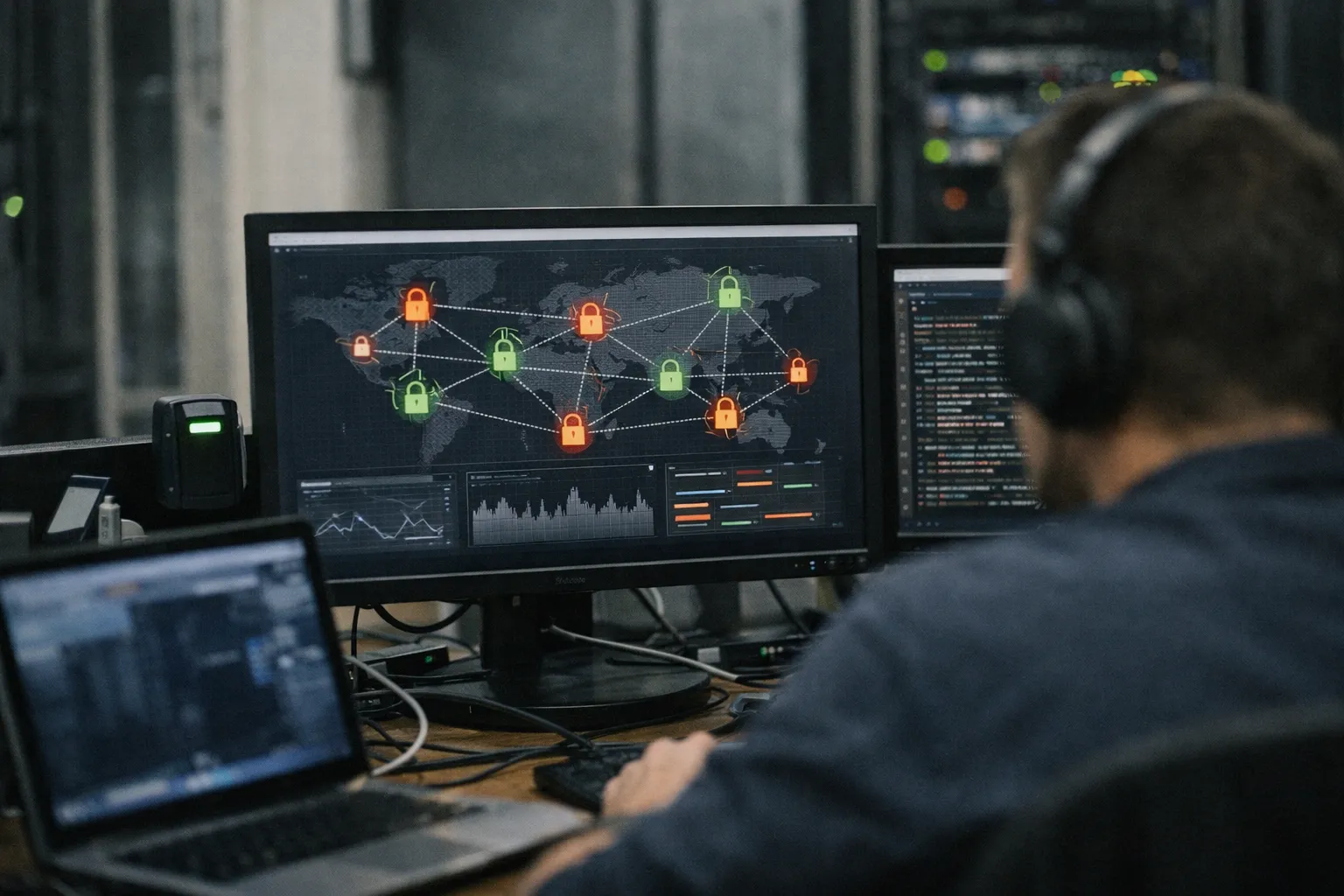
Third‑party vendor access remains one of the most persistent enterprise risks. High‑profile supply‑chain and vendor incidents over the last half‑decade — from SolarWinds (2020) to the MOVEit compromises — underline a single lesson: standing trust for external parties is a liability. Just‑in‑time (JIT) zero‑trust vendor access replaces always‑on access with short‑lived, tightly scoped sessions, verified device posture, and automated revocation. This refreshed October 2026 guide adds recent operational patterns, tooling maturity, and regulatory context so you can deploy JIT vendor access with confidence.
Who this guide is for and what you'll achieve
This article is written for zero‑trust networking practitioners, architects, and security operations teams who need a practical, repeatable plan to implement JIT vendor access across hybrid and multi‑cloud environments, plus SaaS vendor integrations. By the end you’ll have a step‑by‑step deployment plan updated for 2026 realities, concrete policy templates (including credentialless and confidential‑compute options), tooling categories mapped to controls, an onboarding/offboarding checklist, monitoring/KPIs aligned to modern SIEM/XDR workflows, and an FAQ addressing common 2026 questions.
Prerequisites / Context
Before you start, ensure you have:
- An enterprise IdP that supports SAML/OIDC, passkeys/FIDO2 (or equivalent hardware keys), and short‑lived service identities.
- API‑first ZTNA or brokered access solution with session recording and policy hooks.
- Secrets management and cloud STS capable of issuing ephemeral credentials via API.
- Device posture signals (EDR/XDR, MDM, TPM/SE attestation) available to a policy engine.
- Automation/orchestration (CI/CD/IaC) pipelines to instantiate and destroy ephemeral hosts or gateways.
- Legal and privacy review for session recording and cross‑border data transfers.
Why update for 2026: key trends and implications
- Wider adoption of credentialless authentication: FIDO2/passkeys are now widely supported in enterprise IdPs; use them to reduce phishing and credential reuse risk for vendor access.
- Confidential computing and ephemeral enclaves: cloud providers now offer mainstream confidential VMs and enclaves (e.g., Nitro/SEV style tech) suitable for housing vendor tasks that touch sensitive data without exposing plaintext to host operators.
- AI‑driven behavioral detection for sessions: modern SIEM/XDR platforms include behavioral models trained on vendor vs. employee sessions that can flag anomalous lateral movement faster than rule‑based systems.
- Regulatory pressure: directives like NIS2 and expanded incident reporting obligations in multiple jurisdictions have increased scrutiny on third‑party access controls and contractual SLAs.
- Standardization around token exchange and constrained delegation: OAuth 2.0 Token Exchange (RFC 8693) and short‑lived STS patterns are now commonplace for service‑to‑service vendor integrations.
Threat model and design goals (2026 lens)
Map goals to present threats:
- Minimize blast radius: use least‑privilege resource scoping, ephemeral compute/enclaves, network microsegmentation.
- Eliminate standing credentials: prefer passkeys and ephemeral tokens; remove long‑lived service keys from configs and repos.
- Continuous and conditional trust: move from one‑time checks to continuous attestation (session posture, AI anomaly scoring, token refresh policies).
- Auditability and reproducible forensics: immutable logs, session recordings (where lawful), and cryptographic log attestations.
- Automated lifecycle: orchestration that provisions, monitors, and destroys access without manual gating in normal operations; integrations for emergency workflows.
High‑level architecture patterns (updated)
Three practical patterns remain, with modern options to combine them:
1. Brokered ZTNA reverse access (best for managed services)
Vendors initiate outbound connections to a control plane that brokers sessions into internal resources. In 2026, choose brokers that support policy‑as‑code, continuous attestation, session recording, AI anomaly hooks, and integration with confidential compute for high‑sensitivity tasks. Benefits: no public ingress, centralized policy, and strong audit trail.
2. Ephemeral bastion / enclave‑backed jump hosts (for shell/desktop access)
Launch disposable bastions or confidential VMs per session, accessible via brokered ZTNA. Use ephemeral credentials (FIDO2-backed or STS tokens) and destroy the instance post‑session. For very sensitive data, run vendor tools inside confidential compute enclaves so data never appears in plain form on shared hosts.
3. Token exchange + API gateway (for service integrations)
Issue constrained OAuth2 tokens and use token exchange patterns for delegated scopes. Enforce rate limits, per‑endpoint ABAC rules, and continuous telemetry on API calls. Implement mTLS or client‑certificate attestation where appropriate, and leverage API gateways that support dynamic policy updates and anomaly scoring.
Step‑by‑step deployment plan (9 updated steps)
-
Inventory, classify, and prioritize vendor access
Catalog every third‑party relationship and connection type: human access, API/service integrations, managed services, SaaS connectors. Include required resources, data sensitivity, regulatory context, existing credentials, and SLAs. Prioritize by risk and business criticality — begin with high‑risk vendors that touch personal data or critical production systems.
-
Define JIT policy templates (policy‑as‑code)
Create policy templates that map risk class to controls and encode them in your policy repository (Git). Attributes to include (2026 additions in bold):
- Maximum session TTL (e.g., 45 minutes shell; 15 minutes DB console)
- Allowed resource scope: VPC/subnet, instance IDs, API paths
- Authentication: IdP SSO + MFA or passkey; deny legacy password use
- Authorization: RBAC + ABAC with attributes like vendor_org, contract_id
- Posture: EDR + OS patch window + TPM/FIDO attestation
- Runtime: run in confidential compute (if required)
- Monitoring: terminal recording, L7 packet capture, AI risk score thresholds
- Reauthorization and escalation rules
-
Choose and integrate core components (API‑first)
Map policies to tooling categories, and require API automation in procurement:
- IdP: OIDC/SAML + FIDO2/passkey support + short‑lived service identities
- ZTNA broker/gateway: supports reverse access, session recording, continuous attestation
- Secrets & STS: single‑use, short‑TTL tokens, and OAuth token exchange support
- Posture/attestation engine: EDR/MDM/TLS cert/Post‑quantum attestation (if applicable)
- Confidential compute: provider‑offered confidential VMs or enclave services
- Audit/forensics: immutable log store with cryptographic attestations and SIEM/XDR integration
Integration examples: IdP groups → policy templates; ticket system → broker API to instantiate session; secrets manager → STS token issuance with single‑use refresh tokens.
-
Implement secure onboarding & identity federation
Require vendor federation where possible. When federation is not feasible, issue short‑lived identities in your IdP tied to contract expiration and automated deprovisioning. Prefer passkeys/FIDO2 for human vendor accounts to reduce credential compromise risk.
-
Enforce device & session posture continuously
Use pre‑session checks and continuous session attestation: EDR posture, TLS cert checks, TPM/FIDO attestation, and application whitelisting. Configure remediation redirect flows that allow only tightly constrained remediation connectivity (e.g., a remediation VLAN with no data egress).
-
Automate provisioning, rotation, and revocation
Automate session lifecycle via APIs and IaC. Ensure:
- Sessions are created only after ticketed approval or automated policy enforcement
- Credentials are single‑use or TTL‑bound and rotated automatically
- Orchestration tears down ephemeral compute and revokes secrets on TTL expiry or policy breach
-
Instrument monitoring, AI‑assisted alerting, and recording
Capture identity, posture, session start/end, commands, file transfers, and API calls. Feed telemetry into SIEM/XDR and apply AI/behavioral models that can distinguish vendor activity patterns. Set automated response playbooks: quarantine sessions, rotate tokens, and revoke access when scores exceed thresholds.
-
Operationalize vendor workflows and contracts
Formalize request/approval/escalation/emergency workflows in both process and contract language. Contract clauses should require vendor support for federation, credential hygiene, breach notification timelines, and audit cooperation. Example workflows:
- Standard request: ticket → identity verification → JIT session issued for predefined TTL
- Emergency: dual approver, mandatory recording, post‑session review, and automatic forensic snapshot
-
Pilot, measure, and scale
Begin pilot with a narrowly scoped, high‑value use case (e.g., quarterly database maintenance on a non‑prod cluster). Measure KPIs, collect operator feedback, refine automation and policies, then expand by risk tier.
Concrete policy examples (updated for 2026)
SSH shell access — High risk
- Max TTL: 45 minutes
- Allowed targets: instances tagged env:staging & role:db‑admin; run in confidential VM if data exfiltration risk exists
- Device posture: EDR present and healthy; OS patch within 30 days; TPM attestation
- Authentication: IdP federation with FIDO2 passkey; no passwords
- Recording: terminal and keystroke recording enabled; immutable logs stored with cryptographic attestation
- AI score: automatic termination if session risk score exceeds threshold
API integration — Medium risk
- Token TTL: 10–15 minutes; refresh via OAuth token exchange with constrained scopes
- Scopes: least privilege, e.g., GET /orders/* only
- Rate limit: 100 req/min with burst controls
- Posture: mutual TLS or client certificate; service identity rotation enforced monthly
- Auditing: full request/response logs retained per regulatory requirements
Tooling choices and procurement checklist
Procure components that are API‑first, support policy as code, and integrate with your SIEM/XDR. Require:
- ZTNA broker: reverse‑connect, session recording, API hooks, policy as code
- Secrets/STS: single‑use tokens, token exchange support
- IdP: FIDO2/passkey support, short‑lived service accounts, conditional access
- Posture/EDR: real‑time posture API and attestation
- Confidential compute: provider‑managed enclaves/VMs for sensitive processing
- SIEM/XDR: behavioral analytics, playbook automation, and immutable log storage
Automation patterns (2026)
- Ticket → broker API: ticket approvals create sessions via API and return ephemeral connection details to vendor.
- Event‑driven revocation: IdP compromise signals or contract termination trigger immediate API revocation.
- Disposable compute via IaC: golden images launched with ephemeral metadata; destroyed on session close with forensic snapshot taken.
- Policy as code: policies validated in CI, deployed automatically, and audited for drift.
- AI‑assisted playbooks: anomaly detection triggers automated containment measures during vendor sessions.
Monitoring, KPIs and audits (what to measure)
Track these KPIs both in pilot and production:
- Percent of vendor sessions issued through JIT (goal: most critical vendors on JIT within 90 days of rollout)
- Average session TTL vs. business‑required minimum
- Standing vendor accounts remaining (goal: 0)
- Time from automated revocation trigger to effective termination (goal: seconds to under 1 minute)
- Number of anomalous vendor session detections and mean time to investigate
Quarterly audits should validate policy adherence, retention of required logs, and proof‑of‑destruction for ephemeral compute. Consider cryptographic log attestation to establish tamper evidence.
Onboarding and offboarding checklist
- Pre‑onboard: signed access contract, defined scope, security requirements (e.g., passkey requirement), and resource list.
- Onboard: configure federation or short‑lived IdP account, apply JIT policy template, test posture checks and session recording.
- Operational: schedule contract & access review cadence, enforce least privilege, rotate any persistent credentials.
- Offboard: immediate IdP disable, revoke all active tokens, destroy ephemeral hosts, and retain audit logs per policy.
Common pitfalls and mitigations
- Overly broad exceptions: enforce time‑boxed exception policies and require business and security sign‑off.
- Legacy credentials: identify and remove long‑lived keys from repos and build pipeline guards to prevent reintroduction.
- Insufficient telemetry: ensure terminal recording, L7 flows, and immutable logs are available; validate log integrity periodically.
- Legal/regulatory gaps: session recording and cross‑border data transfers require legal review; implement redaction and consent where necessary.
Regulatory and privacy considerations (2026)
Legal and privacy teams must be engaged early. Directives like NIS2 and expanded incident reporting obligations in multiple jurisdictions have increased accountability for third‑party controls. Session recording and keystroke capture may be restricted by local law — use configurable redaction, store only metadata where necessary, and adopt strong data retention and access controls. For vendors operating across borders, contractually specify where logs and recordings are stored and which legal regime applies.
Scaling beyond the pilot
Prioritize additional rollouts by risk tier and contract scope. Maintain a centralized entitlement catalog, enforce continuous attestation, and iterate policy templates using operational telemetry. Make JIT the default by automating approvals for low‑risk access while using human approval for high‑risk sessions.
Common mistakes to avoid
- Relying on manual gates that create shadow standing access.
- Assuming posture checks eliminate all risk; they should be combined with continuous monitoring and rapid revocation.
- Neglecting contractual language about access scope, logging, and breach responsibilities.
Pro tips
- Use passkeys (FIDO2) for vendor human accounts to remove password attack vectors.
- Where possible, use confidential compute for vendor tasks that must process sensitive data.
- Train AI/behavioral models with labeled vendor session data to reduce false positives.
- Store policy and entitlement changes in Git with change approvals and audit trails.
FAQ
How do I handle vendors who refuse federation?
Require a contract clause that specifies acceptable access methods; if federation isn’t possible, issue short‑lived IdP accounts with automated expiry and restrict them to limited, auditable JIT sessions. Reduce scope and require additional controls (confidential compute, mandatory session recording, limited network access).
Can confidential compute replace session recording for privacy reasons?
Confidential compute reduces data exposure by keeping data encrypted in protected enclaves, but it does not replace the need for recording metadata and activity logs for audit and incident response. Use confidential compute to limit data exposure and combine it with selective telemetry that meets privacy requirements.
What’s a realistic pilot target for adoption timeline?
Start small: one to three high‑value vendor workflows in a 60–90 day pilot. Use learnings to expand by risk tier; many organizations can move critical vendors to JIT within 3–6 months with adequate automation and contractual alignment.
How should we use AI in vendor session monitoring without creating blind spots?
Use AI models as an augmentation layer: combine rule‑based alerts for known risky behaviors with AI to surface anomalies. Maintain human‑in‑the‑loop review for high‑impact alerts, and continuously retrain models with labeled post‑incident data to reduce drift and false positives.
What contractual language should we insist on?
Require vendor obligations for identity federation or short‑lived credentials, breach notification timelines, right to audit, data handling and retention specifics for session logs, and service level commitments for access revocation. Include technical annexes describing supported authentication and attestation mechanisms.
Conclusion
Just‑in‑time zero‑trust vendor access remains the pragmatic defensive posture against third‑party risk. The building blocks — federated identity with passkeys, ephemeral credentials, continuous posture attestation, session brokerage, confidential compute, and automation — are mature in 2026. Start with a focused pilot, codify policies as code, automate lifecycle actions, and integrate AI‑assisted detection to make JIT vendor access the default across your environment.